

Pu’er Forumserves as a high-level think tank for the GFN operation.
Convened biennially, Pu’er Forum is a robust platform for knowledge exchange and learning, creating opportunities for stakeholders to explore collaborative initiatives that can benefit the entire region. By focusing on cooperation, the event has paved the way for innovative solutions and partnerships that can address shared challenges and promote sustainable forestry practices across the Asia-Pacific region. The outcomes of this Forum are expected to contribute to the advancement of regional forestry goals, ensuring a more sustainable and resilient future for the sector.
The gathering of 150 representatives from government forest authorities, research institutes, academies, IGOs/NGOs, and the private sector across 14 Asia-Pacific countries marks a significant step toward fostering collaboration and knowledge-sharing in the forestry sector. Through high-level discussions, technical workshops, and informal off-agenda exchanges, participants were able to share valuable insights and perspectives on critical issues related to forestry policy, planning, industry, technology, and education.
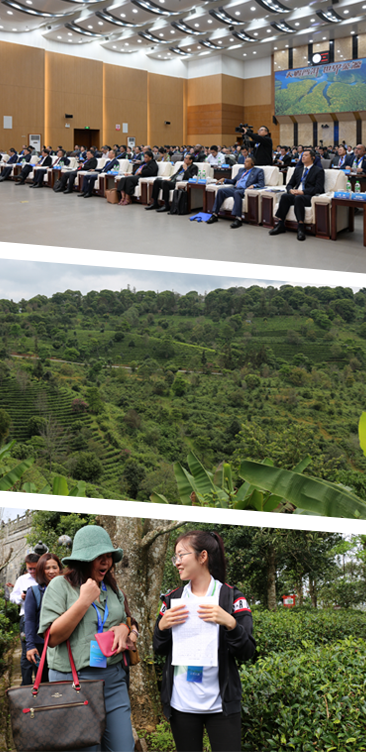
The segment, themed Sharing New Regional Forestry Development, Exploring New Regional Forestry Cooperation, invited 7 senior government officials who shared the most recent developments in forest legislation and policies, national programs and actions, urged more extensive exchanges and strengthened collaboration, and reaffirmed strong political will to thrive regional forestry for sustainable development.
Presentations and discussions around 2 themes, Sharing New Forestry Planning and Exploring the Best Paths for Forest Restoration and Sharing Good Practice Cases on Sustainable Forest Management and Utilization revealed that Asia and the Pacific have placed increasing importance on the role of forests in green and sustainable development, responding to climate change, and protecting biodiversity. They have strengthened legislation, updated their national policies, improved forest sector planning, and carried out large-scale afforestation and restoration operations. However, several areas require further attention, including forest/land tenure reforms, financial support, and capacity building to balance conservation and development and enhance forests’ contributions to national economies.
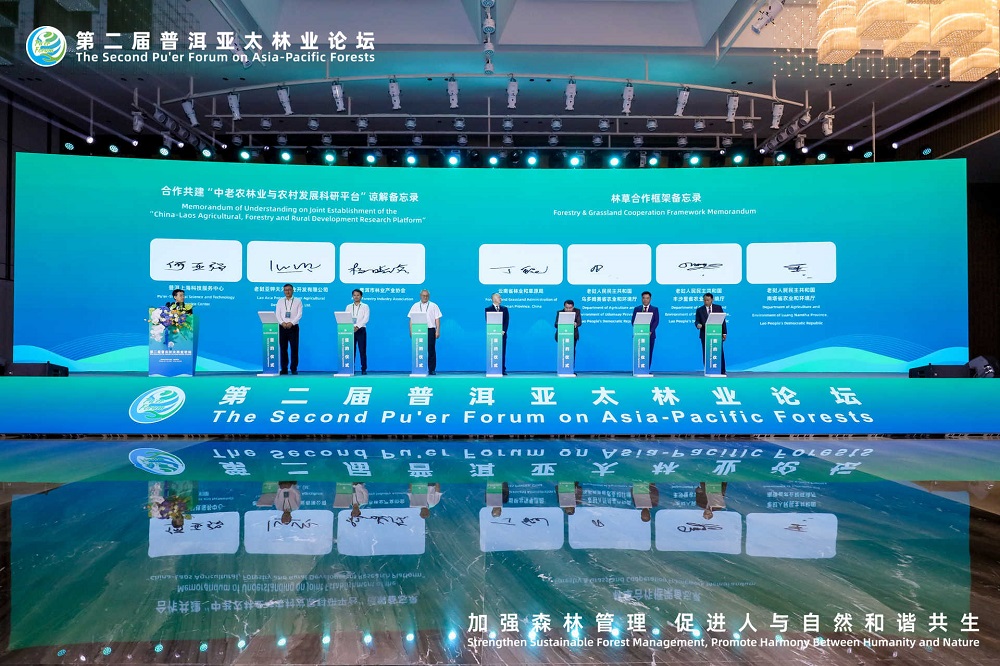
5 cooperation documents were signed to mark commitments of regional partners on joint actions in exchange and cooperation in human resources and techniques, education, research, and business.
Partners will actively implement the cooperation agreements signed at the Forum.
Stakeholders will collaborate and prepare for the second Pu’er Forum in October 2025.
The project the Asia-Pacific Forestry Technology Training Center for Pacific Island Countries will be launched in Fiji in 2024.
Young forestry scholar exchanges among China and ASEAN members will be supported through the APFNet-initiated SANFRI mechanism.
The Summer Camp for Greater Mekong Subregion Forestry Undergraduates Program and the GMS Forest Restoration Demonstration Project will be supported by the Presidents' Forum of Forestry University/Institute in Greater Mekong Sub-region.
International training courses will be organized for South and Southeast Asian tea farmers.
A scholarship program will be established jointly by APFNet and Anhui Gujing Distillery Company Ltd. to support Cambodian and Laotian foresters for postgraduate degrees in China.
The Second Pu’er Forum on Asia-Pacific Forests was successfully held from October 28 to 30, 2025, in Pu'er City, Yunnan Province, China. The event brought together around 300 participants, including representatives from forestry authorities, international organizations, research and academic institutions, and enterprises across over 20 economies in the Asia-Pacific region.
The Forum featured a high-level segment themed "Building a Green Future: New Pathways for Sustainable Forestry Development in the Asia-Pacific Region". Parallel sub-forums were organized covering a wide range of topics, including the forestry industry, policy, education, sustainable forest management and carbon sequestration, nature education, and biodiversity conservation. A special "Pu'er Day" event was also held. During the sessions, participants engaged in extensive exchanges on the above topics and explored pathways for practical cooperation.
The Forum witnessed the signing of a series of cooperative agreements. These included MOUs on forestry and grassland collaboration between the Yunnan Forestry and Grassland Administration and three provinces of Lao PDR (Oudomxay, Luang Namtha, Phongsaly), as well as agreements between Pu'er City and businesses on under-forest medicinal herb planting, wood-based panel production, and financing for national forest reserve projects.
To further promote practical cooperation in the region, based on the discussions and suggestions during the Forum, Action Plan for the Pu'er Forum on Asia-Pacific Forests (2026-2027) (hereinafter referred to as the Action Plan) has been formulated as follows:
Signatories will actively promote the implementation of the cooperation agreements signed during the Forum, and make substantial progress.
Stakeholders will collaborate to design and prepare for the Third Pu’er Forum on Asia-Pacific Forests to be held in October 2027.
Supporting young forestry scholar exchanges from China and ASEAN economies through APFNet Center for SANFRI Young Scholar Exchange, which was jointly established by APFNet and Yunnan Academy of Forestry and Grassland.
Continuously supporting the “Summer Camp for Greater Mekong Sub-Region Forestry Undergraduates Program” under the Presidents' Forum of Forestry University/Institute in the Greater Mekong Sub-region (GMS).
With the academic strengths of Southwest Forestry University, scholarship students from the Greater Mekong Sub-region are enrolled to facilitate the cultivation of the next-generation forestry talents.
With the advantages of the tea industry in Pu'er City, conducting international training in the tea business for South Asian and Southeast Asian tea farmers every year.
Implementing the Global Development Initiative, uphold the principle of extensive consultation and joint contribution for shared benefit, advance the Global Network for Sustainable Forest Management (GFN) with solid and practical actions, and contribute to building a community of life for humanity and nature.