From 9 to 13 March 2026, Dr. Wang Chunfeng, Executive Director of the Asia-Pacific Network for Sustainable Forest Management and Rehabilitation (APFNet), led a team on a field visit to Anhui and Hainan Provinces to review the progress of two APFNet-funded projects: the “Demonstration Project on Forest Restoration and Sustainable Management in the Hilly and Low Mountain Areas of Southern China” and the “Hainan Tropical Forest Restoration and Sustainable Management Project.”
In Qingyang County of Chizhou City, Anhui Province, APFNet conducted a field visit to the Qingyang project sites of the Demonstration Project on Forest Restoration and Sustainable Management in the Hilly and Low Mountain Areas of Southern China, which is led by the Research Institute of Forestry (RIF) under the Chinese Academy of Forestry (CAF). During the visit, the team reviewed several technical approaches demonstrated under Phases I and II of the projects, including restoration of degraded forests in stony hill , quality improvement of secondary forests, broad-leaved enrichment of Chinese fir plantations, and intensive management of bamboo forests. The team also held on-site discussions on key technical practices, implementation outcomes, and the potential for summarizing and scaling up these models.
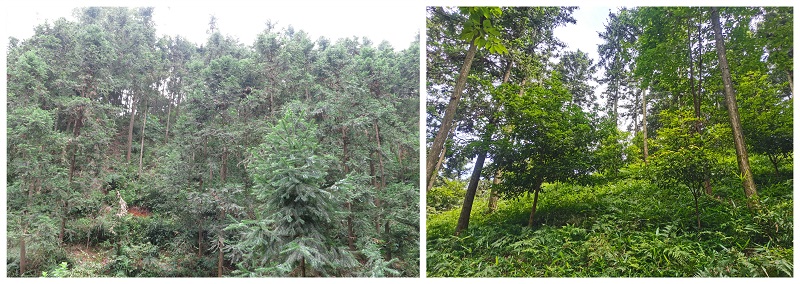
Restoration of Chinese fir plantation (2017/left, 2026/right) in Phase I
In recognizing the progress achieved at the Qingyang project sites, Dr. Wang Chunfeng emphasized that Phase II should build on the achievements of Phase I and current forest conditions, while further exploring approaches that integrate forest quality improvement with income generation for local communities. He highlighted the importance of documenting and disseminating replicable and scalable technical models, developing practical technical guidelines, and encouraging the active participation of local communities, with a view to developing the “Qingyang Model” as a reference for other economies in the Asia-Pacific region.
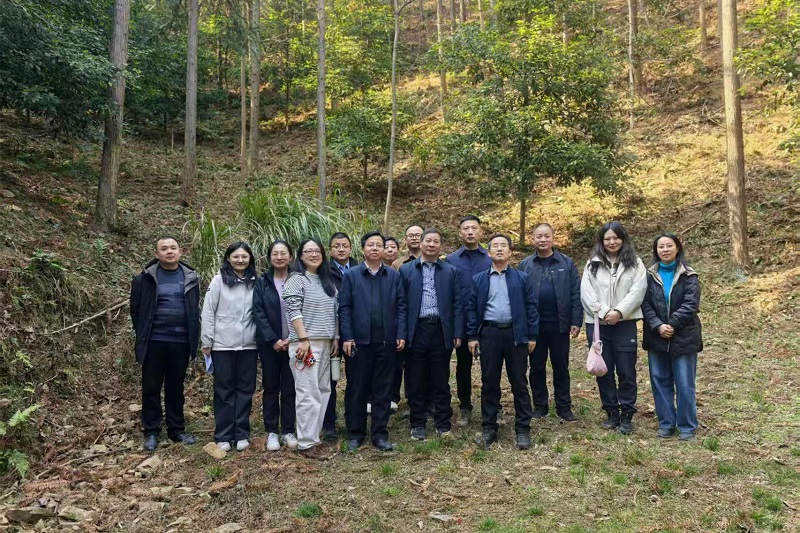
The team of APFNet and RIF, CAF conducted a field visit in Qingyang County, Anhui Province.
In Ledong County of Hainan Province, the “Hainan Tropical Forest Restoration and Sustainable Management Project” is being implemented by the Experimental Station of the Research Institute of Tropical Forestry under the Chinese Academy of Forestry located in Jian Feng Town. During the visit, the team visited the demonstration plots for the ecological restoration of eucalyptus plantations, the Experimental Station’s butterfly specimen museum, arboretum, Jianfengling Forest Ecosystem National Observation and Research Station, and its nature education facilities. After the field visits, a meeting was also held to exchange views on future cooperation.
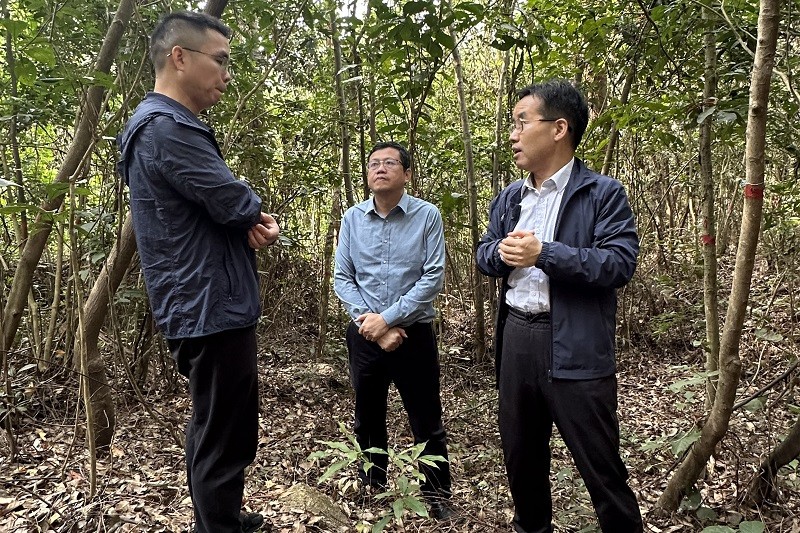
Project demonstration plots for the ecological restoration of eucalyptus plantations
Dr. Wang acknowledged the significance of the project’s efforts in the Jian Feng Ling area in the context of the Hainan National Park development. By applying ecological principles, the project aims to explore the ecological restoration and transformation of monoculture plantations such as eucalyptus, facilitating their transition toward structures more similar to natural forests. He also expressed the hope that the project would further strengthen the exploration of restorative approaches and develop demonstrative models of tropical forest restoration that can be showcased and promoted to regional economies, particularly in Southeast Asia.
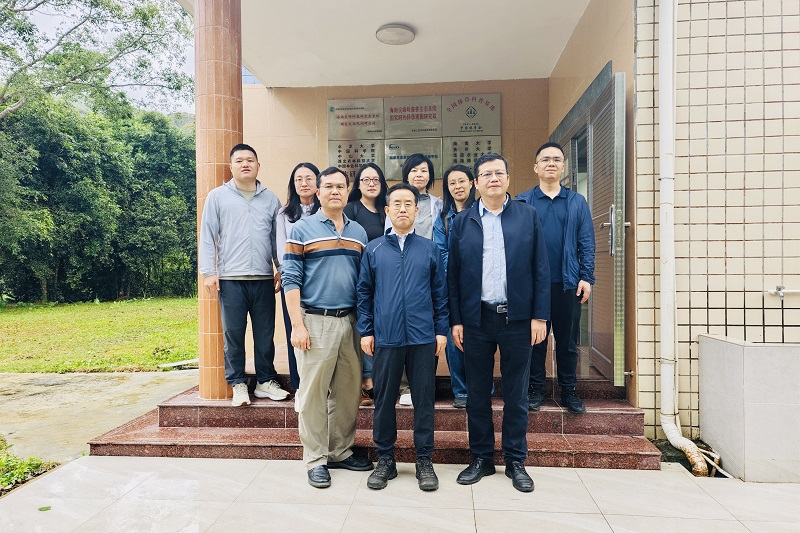
Hainan Jianfengling Forest Ecosystem National Observation and Research Station
Looking ahead, APFNet will align its efforts with its Fourth Strategic Plan (2026–2030) to further advance technological innovation and benefit monitoring under the demonstration projects in Anhui and Hainan. Meanwhile, APFNet will also promote the development and synthesis of replicable, scalable, and sustainable demonstration models for forest restoration, rehabilitation, and management, with a view to achieving the expected project outcomes.